
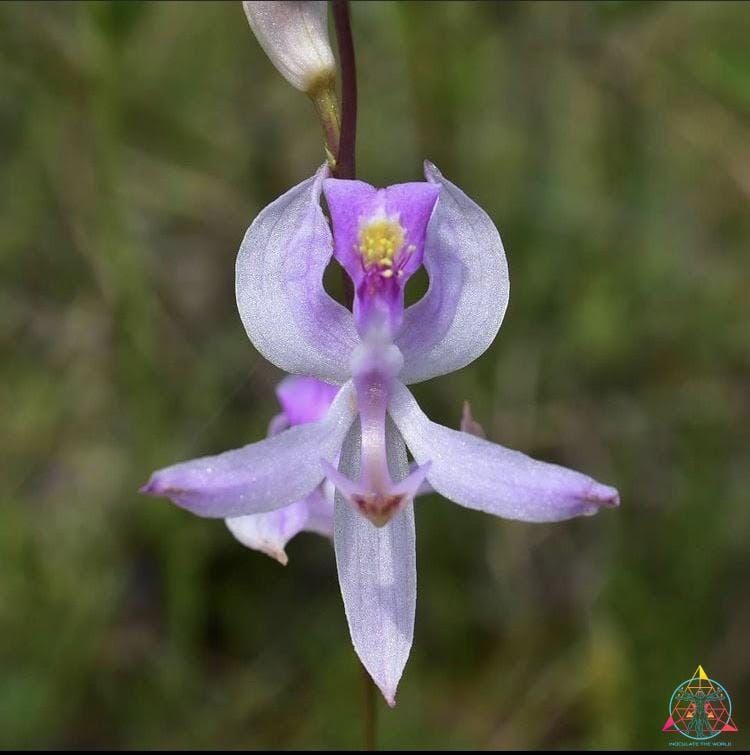

Photo: Joey Santore (pogonia ophioglossoides)
Orchids + Funguses
By: C_Y_Spam
If you can believe it, until about the 60’s, the scientific community considered the immense world of fungi to be a mere offshoot of the plant kingdom. Though we now know much more about the unique branch they hold on the tree of life, these first guesses weren’t entirely wrong. In fact, an estimated 90% of plants associate with fungi in the soil, and a majority of those plants would die without their mycological partners-in-crime. Orchid seeds, for example, will fail to grow beyond germination if they aren’t in contact with a fungus in the soil. Unlike most other plants, orchids don’t pack food into their seeds to kickstart growth, so it’s up to each seed to meet a fungal associate, and begin siphoning energy away from the fungi, which is hard at work digesting dead biomass or connecting trees via mycelial networks. It’s not all one-sided, though. Most orchids, being the considerate creatures they are, will send back a portion of the energy they create once they’re aboveground and photosynthesizing. In return, they receive a supply of essential nutrients, like nitrogen, phosphorus, and zinc, and so both parties benefit. These instances of mutualism happening right under our feet, starting from spores to mycelial networks, offer a fascinating look into the relationships of the other-than-human world, and serve to remind us that oftentimes, kindness and generosity are the best assets to have.
Sources:
Cameron, Duncan D., et al. “Mutualistic Mycorrhiza in Orchids: Evidence from Plant-Fungus Carbon and Nitrogen Transfers in the Green-Leaved Terrestrial Orchid Goodyera Repens.” New Phytologist, vol. 171, no. 2, 2006, pp. 405–16. Crossref, doi:10.1111/j.1469-8137.2006.01767.x.
Libretexts. “24.2B: Mutualistic Relationships with Fungi and Fungivores.” Biology LibreTexts, 15 Aug. 2020
Lowman, Margaret, and Bruce Rinker. “Orchid Adaptations to an Epiphytic Lifestyle.” Forest Canopies (Physiological Ecology), 2nd ed., Academic Press, 2004, pp. 187–88.


Related Articles
The Curious Case of the Grey-Market Mushroom Edibles
The views and opinions expressed in this piece are solely those of the author, and are not representative of Inoculate the World as a company. "Magic Mushroom" Edibles are Everywhere. What's the Deal? Six years ago, very few American psychedelic users had...
The Path Forward for Psychedelic Therapy
Everyone’s talking about the psychedelic renaissance, and the medical applications for psychedelics are a huge part of that discussion. Psychedelic legalization has been a winding path in the United States. The War on Drugs of the 1960s ushered in a ‘psychedelic dark...
The Rising Potential of Indigenous African Mushroom Cultivation
When we think of gourmet mushrooms, we typically think of the classics: oyster mushrooms (Pleurotus ostreatus) and shiitake (Lentinula edobes), or perhaps the lesser-known but equally delicious chestnut mushrooms (Pholiota adiposa). Beyond this familiar lineup,...